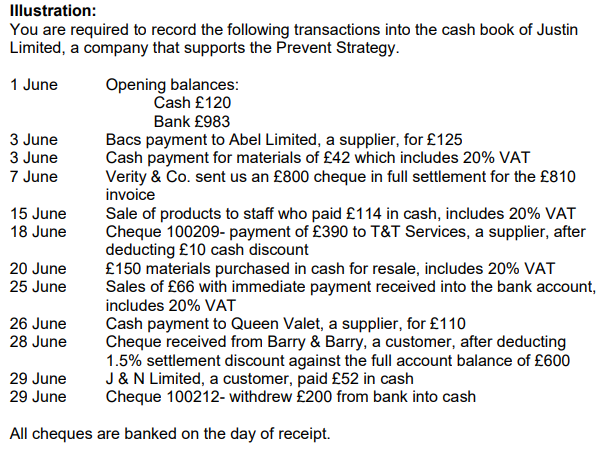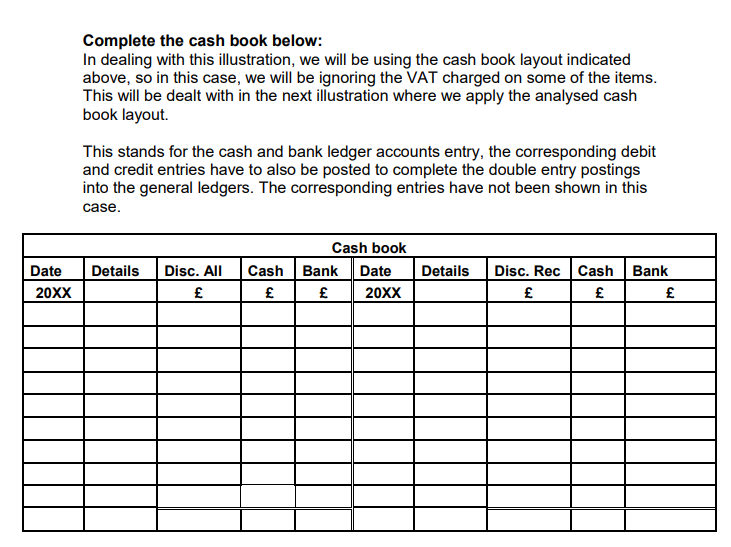
The Cash book is a book of prime entry which is initially used to record all money transactions and then transferred into the general ledger. All monies received or paid out will have an entry in the cash book and this will include monies paid in and out in cash or through the bank.
In the accounting system and in the context of your assessment, you need to know that the cash book may combine the roles of the book of prime entry and the double entry bookkeeping, where it is maintained as a bank ledger account with debit and credit sides to the cash book. It can be maintained as a separate accounting record from the bank ledger account or kept together.
Cash book layout-
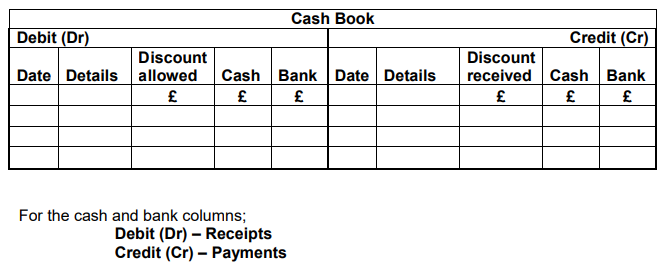
The cash book layout can be set up in different formats to suit the business. In this
case, the cash and bank accounts have been accounted for together in the same
cash book, where the debit column for cash is put next to the debit column for bank
and the credit column for cash is put next to the credit column for bank. The bank
columns deal with movement of monies in the real bank for which bank statements
are periodically received from the bank and reconciliations can then be carried out.
The cash column deals with movement of cash within the business.
The VAT and Discounts columns in the cash book do not form part of the double
entry postings, they are used as memorandum columns to list the VAT and
discounts not yet posted into the ledger, eg VAT arising from cash sales or cash
discounts taken up for early settlements. These need to be totalled and transferred
into the double entry system, that is, the debit and credit entries will need to be
posted.
Balancing the cash book
On a regular basis- weekly or monthly, ledger accounts will need to be balanced
and closed off, showing the closing balance for the period. This periodic balancing
needs to be carried out in the cash book where the cash book is used as a ledger
account alongside being a book of prime entry.
The cash columns and the bank columns need to be balanced separately as these
represent two different ledger accounts. The VAT, Discounts and Analyses
columns in the cash book do not form part of the double entry postings, so these
columns do not need to be balanced off. The VAT and Discounts columns
should be added and then posted to the relevant ledgers in compliance with double
entry.
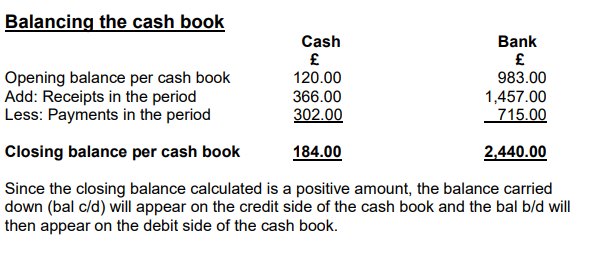
The following brief calculation will enable you find the cash book balance for the
cash and bank columns. This is particularly useful where separate receipts and
payments books may be maintained as seen in the analysed cash book.
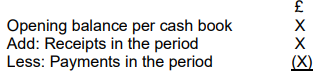

If the closing balance calculated is a positive amount, the balance carried down
(bal c/d) will appear on the credit side of the cash book as a surplus in amount left
over from the trading period, but if it is a negative amount indicating an overspend
which is possible in the bank as bank overdraft, the balance carried down will be
on the debit side of the cash book.